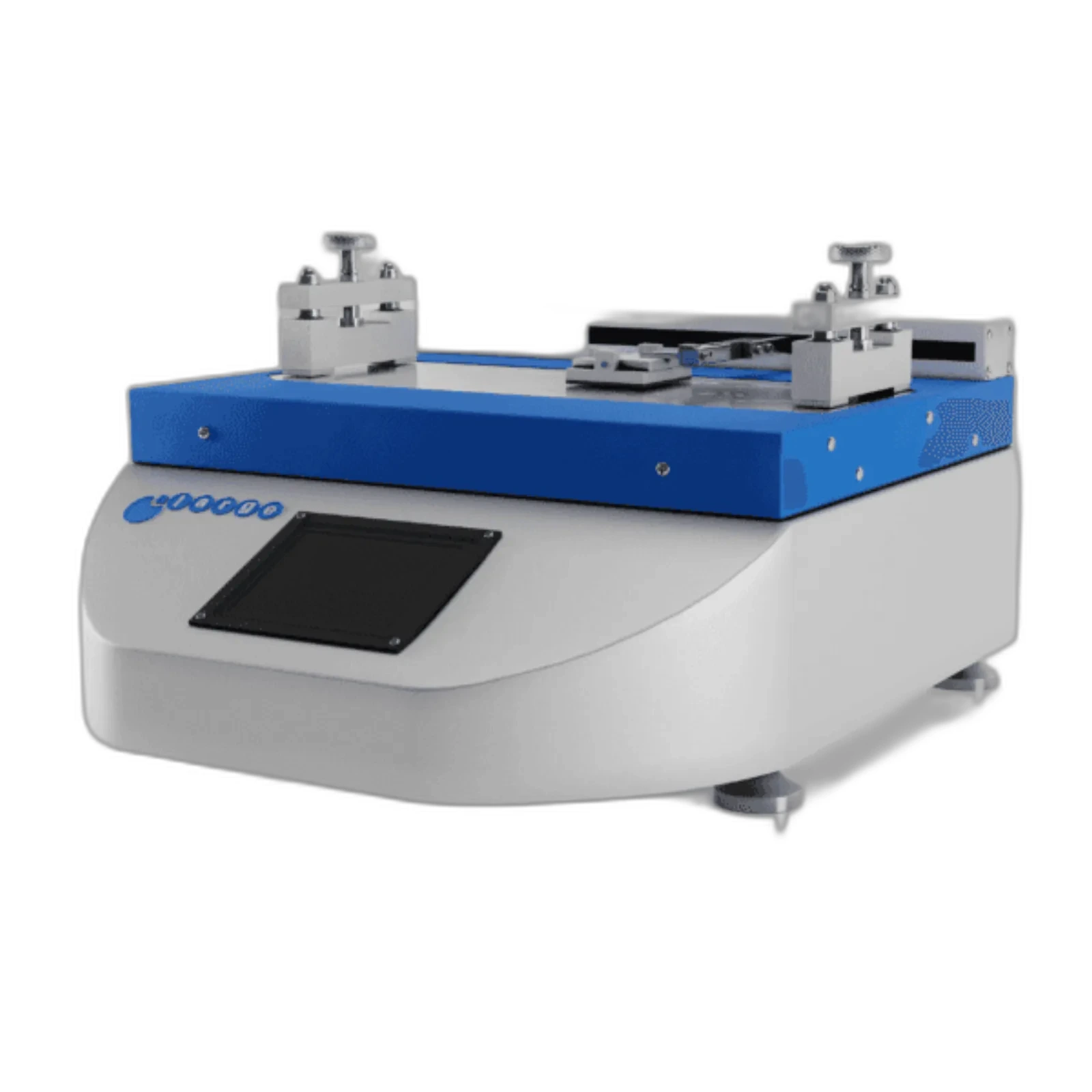
About This Machine
Product Overview
Mide los coeficientes de fricción estática y dinámica de las películas poliméricas, materiales de embalaje, y superficies. Imprescindible para los envases flexibles, envases alimentarios, médico, y aplicaciones en el sector de la automoción.
Características principales
- Rango de velocidad: 100–1.000 mm/min
- Recorrido: 100 mm
- Sensibilidad: 0,1 g
- Superficie de examen cromada
- Control mediante pantalla táctil
- Grabación de datos mediante USB
- Precisión del 5 % en FS
Especificaciones
- ISO 8295 — Plásticos — Determinación del coeficiente de fricción
- ASTM D 1894 — Coeficiente de fricción estático y cinético de películas y láminas de plástico
Especificaciones
- Rango de velocidades100–1.000 mm/min
- Distancia recorrida100 mm
- Sensibilidad0,1 g
- Precisión5 % FS
- Accidente cerebrovascular200 mm
- ReglamentoPantalla táctil
- Superficie de ensayoCromado
Preguntas frecuentes
- Q¿Cuál es la diferencia entre el coeficiente de fricción estático y el cinético?
- AEl coeficiente de fricción estático (COF) es la fuerza necesaria para iniciar el deslizamiento dividida por la fuerza normal; El coeficiente de fricción cinético (COF) es la fuerza necesaria para mantener el deslizamiento a una velocidad constante, dividida por la fuerza normal. Ambas son magnitudes adimensionales.
- Q¿Qué normas cumple el analizador?
- ALa norma ISO 8295 para películas y láminas poliméricas y la norma ASTM D1894 para el coeficiente de fricción (COF) estático y cinético de las películas poliméricas.
- Q¿Por qué es importante el COF en el sector del embalaje?
- AUn coeficiente de fricción (COF) demasiado elevado hace que la película se pegue y se atasque en las máquinas de envasado; Si es demasiado baja, hace que se deslice y que las pilas de paquetes se desplacen. Medirlo permite que el rendimiento de la línea sea predecible.
- Q¿Cómo se guardan los resultados?
- AEl examen se controla desde la pantalla táctil y los datos se registran a través de USB.
Technical Data
Specifications
| Parameter | Specification |
|---|---|
| Brand | RTPLINE |
| Code | 9024800000 |
Specifications are configurable to your pipe sizes and test standard. Ask us for the full datasheet and a configuration proposal.
Source: RTPLINE product engineering data · Updated November 2026
FAQ
How many test stations do I need?
Answer: It depends on how many samples you run per day. For occasional testing with a few samples, 3–6 stations are sufficient. For daily batch release or a busy test house, choose 5–30 stations so long-duration tests run in parallel instead of queueing. Send us your daily sample count and we will size the station number for you.
How do I get pricing and a recommended configuration?
Answer: Tell us the pipe diameter range, the test standard (for example ISO 1167 or ASTM D1598/D1599), the number of stations you need and the water-bath size you expect. We will return a configuration proposal with a firm quotation, lead time and shipping terms — normally within one business day.
What are your strengths?
Answer: RTPLINE designs, builds and tests plastic pipe testing and extrusion equipment in-house. Critical components are selected for continuous industrial duty, and every unit is pressure-tested and run before shipment, so performance is repeatable from the first day on your floor.
How will the machine be assembled and debugged when it arrives at the factory, and will the customer's employees be trained?
Answer: The equipment is assembled and debugged at our works before delivery, then packed for shipment. Our engineers provide remote video guidance for installation and commissioning, and on-site installation and operator training can be arranged. Training covers daily operation, changeover, routine maintenance and safety.
What do you do if there is a problem or failure with equipment that requires guidance or replacement parts?
Answer: Send us the symptom and a short video; our service team replies with a diagnosis and step-by-step guidance. If remote support cannot solve it, an engineer can be dispatched to site. Parts replaced during the warranty period are supplied free of charge; wear parts are charged at cost only.
How long is the warranty period of the product?
Answer: Every machine carries a 12-month parts warranty together with lifetime technical support. Consumables and wear parts are excluded, and are quoted at cost.
Can I visit your factory in China?
Answer: Yes. Factory visits are welcome — we can arrange airport pickup and a full demonstration of the machine running with your pipe samples. Video tours are also available if travel is not convenient.
Can you customize according to requirements?
Answer: Yes. Working range, number of stations, fixture sizes, voltage, control interface and guarding can be customized to your pipe sizes, test standard and plant layout. Send your specification and we will propose a configuration.